

- Home »
- Investors »
- Blockchain & Cannabis: Investing Compliance
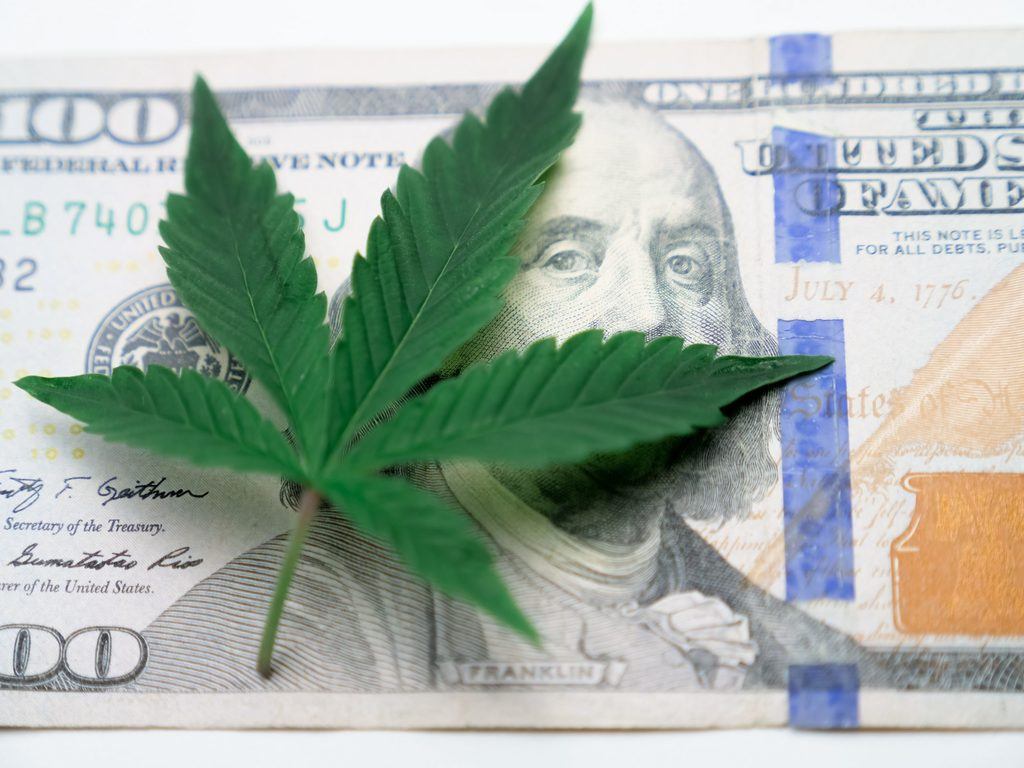
Blockchain & Cannabis: Investing Compliance
To set the stage for blockchain and cannabis compliance, we have to first understand blockchain transactions (this article assumes that you, the reader, are familiar with cannabis, a.k.a. marijuana, Lady Jane, weed, bud, Kush, Sticky-icky, etc. as well).
18 states, as well as the District of Columbia, have legalized marijuana. Meanwhile, thirteen states have removed the jail-time penalty for possessing small amounts of marijuana. This is called “decriminalization.” Additionally, some states have legalized medicinal use for those who are part of the state-run medical cannabis programs.
But before you hop on a plane with a little bud, cannabis remains illegal at the federal level. Thus the need for an alternative to the federally regulated banking system.
What is Blockchain?
Blockchain is like a group text message.
Much like in a group text message, blockchain is a distributed, time-stamped, tamper-resistant record of data transactions. For a moment, imagine you are in a group text. There can be anywhere between 3 and an unlimited number of people in this group text. You know who some people are, because their names and cell phone numbers are known to the group. Others in the group are pseudo-anonymous, as you can see their cell phone numbers, but you do not know their names.
Each time a person sends a message, they create a record of data that is time-stamped, tamper-resistant, and distributed to everyone in the group text message. Keep in mind that data can consist of practically anything, such as a text, a photo, an emoji, a hyperlink to a website, a video of flying squirrels, or an IOU for lunch.
Blockchain is most often used for recording financial transactions. For example:
Samson has $10 (digital dollars). Samson sends (via a text message) Maureen $7. Maureen sends George $3. George sends number (555) 555-5555 seventy-five cents.
Everyone on the blockchain network, like in a group text, can see each and every transaction. Because all transaction records are recorded on the group text (blockchain)—transparent and encrypted (this is the “crypto” part of “cryptocurrencies”)—Samson (or anyone else) cannot reverse the transaction or claim to have money that he doesn’t actually possess.
In this example, Samson now only has $3. Even if Samson deleted the original message or destroyed his phone, the entire history of that group text message is alive and well on everyone else’s phone. This is ensured by the distributed nature of blockchain records. The “phones” of blockchain networks are known as “nodes.” At a high level, this is how blockchain works. Blockchains facilitate the encryption of transaction data that is time-stamped, distributed, and tamper-resistant.
[Editors’ Note: You may also like Blockchain Technology is Revolutionizing the Way We Invest, Borrow and Lend]
So What?
So now that we know blockchain is like a group text message, now what? Why does it seem like everyone is losing their minds? Why all the hype? Simple. There is no bank. In the example above, where everyone is “texting” each other value, or digital dollars called “cryptocurrencies,” where is the bank?
With decentralized ledger technology (DLT), blockchain’s less-sexy name, people can create, account for, and exchange value without a bank. This is important because as value (you may call it money) goes digital, customers are voting with their value on who provides the greatest convenience that they can trust. Is it a bank? Is it the Federal Reserve? Is it Facebook Coin? Or, perhaps it is Apple, who has rolled out its own credit card and, I suspect, its own cryptocurrency shortly hereafter. Maybe JP Morgan and their JPMCoin? That’s a customer service battle that only scale and customer loyalty can determine. However, from a tech perspective, the technology is so old, it’s already a help-desk job.
[Editors’ Note: You may also like Eight Reasons Why Blockchain Technology Won’t Be Stopped (And Shouldn’t)]
Important Water Cooler Sound Bites about Blockchain & Cryptocurrencies:
- You can’t “invest in blockchain.” You can invest in businesses that leverage blockchain technology to be more profitable. If blockchain doesn’t make the business more profitable, then why are you throwing away your money?
- There is no such thing as “the blockchain.” There are numerous blockchains. In short, there can be as many blockchains as there can be group text messages or applications that require a distributed, encrypted, time-stamped record of transactions.
- Less than 1% of businesses will ever be true blockchain businesses. Blockchain is a tool, like MS Excel. You are no more in the blockchain business than you are in the MS Excel business. The real question is, “How can using blockchain make my business money?”
- Blockchains come with risk. Should everyone be able to see all business records?
- Cryptocurrencies are a customer service battle. Customers want convenience in banking. Banking is a verb. Ultimately, customers will choose whichever system (e.g. bank, Facebook, Apple, cellphone, etc.) that can provide them with the most convenient banking services and experiences. To put it into context, how does KYC/AML work on a burner phone?
- Stablecoins don’t exist but come with real risks nonetheless. So, what is a stablecoin? And what exactly makes it “stable?”
- Poor data on a blockchain is simply that. Blockchain isn’t quality assurance for your data.
- Blockchains present a whole new world of cybersecurity risks. With all emerging technology, there are unknown unknowns. With blockchain, from public to private to hybrid, the unknown/unknown risks are multiplied to at least a double-digit exponent. Caution is encouraged; sometimes being the second mouse is a sound strategy.
- Smart Contracts aren’t smart. Nor are contracts. Smart contracts are at best self-executing the “terms and conditions” of a simple transaction. You don’t want to find this out the hard way.
- STOs are PDF signatures you put on a blockchain. STO stands for “security token offering.” A security token represents the ownership information of the investment product recorded on a blockchain. When you invest in traditional stocks, for example, ownership information is written on a document and issued as a digital certificate (e.g. a PDF). For STOs, it’s the same process but recorded on a blockchain and issued as a token. So, what is an STO? It’s a PDF signature you put on a blockchain.
Bonus! Alternative Investments
Whether you’re considering investing in cryptocurrencies, cannabis, businesses that leverage blockchain, or the latest emerging technology, you’re ultimately considering investing in non-traditional, “alternative” investments. Due diligence remains a constant need, and a strong eye on compliance can help reduce your exposure risk.
Lastly, keep in mind that blockchain does not magically resolve even basic business issues, such as operations, customer acquisition, service delivery, or profit generation.
[Editors’ Note: For a comprehensive understanding of alternative assets, we recommend Alternative Assets and the “Average” Accredited Investor Installment #1]
Compliance in the Blockchain Space
Compliance in the blockchain/cryptocurrency space should be treated like laundering money to pay your federal taxes… as many in the regulated cannabis business do. Yes, I know this sounds outlandish. So, let’s do a 30-second compliance exercise.
Question: Is cannabis legal?
Answer: Yes, at the state level in certain states. However, at the federal level, cannabis remains illegal.
Question: Is cannabis regulated by the state?
Answer: Yes, on a case-by-case basis.
Question: Is a regulated medical marijuana or recreational cannabis shop required to pay taxes?
Answer: Yes. All legal businesses must pay all applicable state and local taxes, as well as all required federal income taxes.
Question: How do cannabis businesses open bank accounts?
Answer: Due to cannabis being illegal at the federal level, banks do not wish to risk losing their federal banking charters by opening bank accounts for “illegal drug dealers” and their associated businesses.
Question: How can legal cannabis businesses pay taxes if they cannot open up a bank account?
Answer: State and Local taxes can be paid in person, at the tax office, in cash. The IRS (Internal Revenue Services) does not accept cash payments. Payments made to the IRS must be made by check or via wire transfer.
Question: If the IRS only accepts checks and wire transfers but legal cannabis businesses can’t open a bank account, how does a regulated, legal cannabis business pay its federal taxes?
Answer: *nod and wink*
(Note: In 2018, the IRS collected $2.8 billion in taxes from regulated cannabis businesses.)
From a compliance perspective, whether it’s cryptocurrencies or cannabis investing, the business and operating compliance requirements vary and depend on a number of factors. We recommend you consult with an expert to review your unique circumstances, and develop a plan to enable you and your clients to safely, and securely, invest in these new and emerging alternative investment opportunities.
Digital Assets, Commodities & Securities (DACS), Security Token Offerings (STOs), Initial Coin Offerings (ICOs), Initial Exchange Offerings (IEOs), and so-called “Stable Coins” are all digital ducks. For marketing purposes, they may be called something else, but at the end of the day, they’re digital assets, commodities, and securities. Compliance on DACS is novel, so “marketing ducks” should follow similar best practices as applied to your normal ducks. Get your ducks in a row, and you should be fine. Just don’t forget to consult a professional in alternative investments.
The Real Disruptors of The Future
Everything will be tokenized.
Tokenization presents new, exciting, and wholly uncharted territories for business, law, and compliance. Tokens aren’t securitized, and it’s recommended that you get to know your local Commodities Futures and Trade Commission (CFTC) representative. Because so much in the future will be tokenized including cannabis, cannabis commodities, and cannabis derivatives, along with new, wholly hereunto unknown financial instruments based on blockchain tokens.
The Takeover of Virtual Assistants
Neural Net Learning (e.g. Alexa, Siri) will be more disruptive to your business model and operations than blockchain ever will. From an investing and compliance perspective, in the next 5 years, you will be able to talk to your reports and dashboards much like Michael spoke to KITT (Knight Rider reference). Commercial-grade virtual assistants, combined with voice, will rewrite office operations and consequently change the way you do business, compliance, and investing.
AI will not replace compliance.
However, compliance professionals who use AI will replace those who do not.
Cell phone companies will win the banking customer service battle.
Why is this the case? Because banking is gravy for them, and they already own 100% of your customer’s attention.
Bitcoin isn’t going to replace the USD as the global reserve currency.
The Facebook Coin will.
Last but not least, remember that blockchain isn’t hot sauce. You can’t put that stuff on everything, but you may be able to leverage it to improve your bottom line and revenue.
[Editors’ Note: This article is based on Samson Williams’ keynote speech on blockchain, compliance, and cannabis at the Compliance Solutions Strategy Conference in Miami Beach on April 16th, 2019, which he described as “three days of ethics, compliance, regtech, and legal considerations in business, finance, investing, and emerging opportunities.”
To learn more about this and related topics, you may want to attend the following on-demand webinars (which you can listen to at your leisure and each include a comprehensive customer PowerPoint about the topic):
- Cannabis Investment: Successes, Failures, & Strategies for the Future
- Crypto Currency 101
- Blockchain and Supply Chain
- Blockchain Basics
This is an updated version of an article originally published on June 4, 2019]
©2022. DailyDACTM, LLC d/b/a/ Financial PoiseTM. This article is subject to the disclaimers found here.
About Samson Williams
Samson Williams plys his trade as a classically trained anthropologist who specializes in crisis management for banks, financial institutions and the odds government agency. When not in DC, Samson can be found traveling around Europe and the Middle East lecurting on FinTech, Space Economics and how technology transforms social capital into financial capital. Samson is…