

- Home »
- Commentary »
- Inflation Slows in July, But Can the Inflation Reduction Act Further the Trend?

Inflation Slows in July, But Can the Inflation Reduction Act Further the Trend?
Inflation data came out this morning for July, and everyone concerned about soaring consumer prices might have breathed a small sigh of relief. CNN reports:
Runaway inflation took a breather in July, with consumer prices increasing by 8.5% year over year, a slower pace than the 9.1% increase in June, the Bureau of Labor Statistics reported Wednesday.
On a month-to-month basis, prices held steady, compared to the 1.3% increase in June.
Core inflation, which does not include volatile food and fuel components, was unchanged on a year-over-year basis after June’s 5.9% jump.
This is certainly a welcome development, and is already spurring a cacophony of speculation on what this means the Federal Reserve will do next. However, for those whose wallets have been taking a hit, it’s worth noting two things.
First, 8.5 percent year over year inflation is still not great. Though it’s below the U.S. all-time high of 13.55% (hello, 1980), the average inflation rate between 1960 and 2021 was only 3.8%. In other words, we’re not out of the woods just yet.
Second, this data does not necessarily indicate a turnaround. Consumer sentiment is often reactive, and the reaction we’re seeing right now is one of unbridled pessimism.
US consumer sentiment hit a new record low as financial conditions worsen
75% of the consumer surveyed declared to be living paycheck to paycheck with issues paying bills pic.twitter.com/qfttt5sMPe
— ??????? (@AlessioUrban) August 7, 2022
Small businesses are echoing this concern. With consumers feeling strained and disposable income limited, they’re bracing themselves for a lean season. CNBC reports:
Small business confidence has hit an all-time low as the majority of Main Street expects runaway inflation and a Federal Reserve that is incapable of engineering a soft landing for the economy, leading to revenue declines and staffing cuts across sectors.
The majority of small business owners (57%) taking part in the CNBC/SurveyMonkey Small Business Survey for Q3 2022 think the recession has already begun, while another 14% predict recession before the end of the year.
This complicates discussions about whether or not we’re headed for or already in a recession. In many ways, sentiment is often the determining factor of whether or not a recession is realized. As behavioral analysis expert and financial educator Kyla Scanlon recently wrote in the New York Times:
The vibes in the economy are … weird. That weirdness has real effects. A recent study found that broader vibes do indeed drive what people do, with media narratives about the economy accounting for 42 percent of the fall in consumer sentiment in the second half of 2021.
Indicators like G.D.P. are important, but much of the time, the root of economic problems lies with expectations. When we think about things like inflation, financial conditions and monetary policy, it’s best to frame them through people. And people are, of course, silly and messy. Far too many economists and experts forget that the economy is really a bunch of people “peopling” around and trying to make sense of this world.
When policy is more focused on indicators that might not fully reflect reality, and not on the silly and messy people whom the policy is meant to serve, we enter dangerous territory.
There is no recession yet. Right now we are in a “vibe-cession” of sorts — a period of declining expectations that people are feeling based on both real-world worries and past experiences. Things are off. And if they don’t improve, we will have to worry about more than bad vibes.
It should, then, come as no surprise that politicians are feeling the heat in terms of finding a solution (even if that heat is looking relatively partisan). They seem to believe they have the answer, though. The question is: do they?
Meet the Inflation Reduction Act
Over the weekend, the Senate narrowly passed the Inflation Reduction Act. The budget reconciliation bill had been bandied about behind closed doors for quite some time before ultimately being decided by a tie-breaking vote from Vice President Kamala Harris. It includes major investments in climate, tax, and healthcare policy, with an aim of reducing consumer costs and the deficit in hopes of curbing runaway inflation.
When asked about how, exactly, that works, director of the National Economic Council Brian Deese explained:
The first is it lowers costs for families. And so millions of families out there who are thinking about how to make their monthly budget add up – it will lower prescription drug costs. It will lower health care premiums. And it will lower energy costs – what people pay on their utility bills or they pay for other things like how to get around. And the second thing it does is it lowers the deficit. By making the tax reforms that you were just discussing, it actually will bring down the federal deficit. And that will be complementary to what the Federal Reserve is trying to do on inflation. And that’s why even Democrats and Republicans, former Treasury secretaries, economists across the board have said that this bill will make a positive impact on inflation while also tackling some of the biggest and longstanding issues facing our country, like prescription drugs and like tackling climate change.
In theory, all of this is a good thing. The Congressional Budget Office projects the initiative will likely reduce the deficit by $102 billion over the next decade (or perhaps as much as $300 billion). It caps out-of-pocket prescription drug costs at $2,000 annually. It doubles down on clean energy, which will help address some of the environmental and public health concerns associated with climate change.
It’s taxes, however, that have many raising an eyebrow and wondering about what comes next for businesses and individuals.
Taxes ARE Going Up, but Probably Not for You
The first point of concern has been the inclusion of a 15% minimum corporate tax rate for companies reporting more than $1 billion in income to shareholders. While the current corporate tax rate rests at 21%, most large corporations are able to reduce that bill substantially by taking advantage of loopholes in the tax code. The new provision would mean they can no longer reduce that bill below the 15% mark, generating an estimated $258 billion in revenue.
Before you begin beating the drum about the mandate being unfair or unwarranted, consider that this provision will most likely apply to a grand total of 150 companies. While that group stands to contribute a substantial amount of tax revenue should the bill become law, the vast majority of business owners will not be impacted. In the meantime, companies best equipped to contribute will have to step up to the plate. As the New York Times reports:
Senator Ron Wyden of Oregon, the chairman of the Senate Finance Committee, shared Joint Committee on Taxation data on Thursday indicating that in 2019, about 100 to 125 corporations reported financial statement income greater than $1 billion, yet their effective tax rates were lower than 5 percent. The average income reported on financial statements to shareholders was nearly $9 billion, but they paid an average effective tax rate of just 1.1 percent.
“Companies are paying rock-bottom rates while reporting record profits to their shareholders,” Mr. Wyden said.
In the meantime, small businesses might actually see some relief from the bill. Tax credits for clean energy structural improvements and the credits extended to clean energy service providers could result in cost-savings come tax time and real-time savings in energy costs. The extension of healthcare credits provide a more stable environment for small businesses offering coverage to their employees. And that 15% tax floor for the largest corporations in the game? It could help smaller business competitiveness.
The Tax Man Cometh… but for Who?
Outside of the direct impact on (a few) corporations and small businesses, talking heads are enjoying bandying about barbs related to individual federal income tax hikes and who, exactly, is going to be affected. The hand-wringing relates to a promise made by President Biden during the election to not raise taxes on those making less than $400,000. Technically, that’s not what the bill does. Indirectly, however, critics believe that’s exactly what happened. A segment from Fox News got into it:
President of Americans for Tax Reform Grover Norquist blasted Joe Biden, accusing the president of lying to Americans as the Inflation Reduction Act hits the middle class with taxes – contrary to his pledge not to raise taxes.
“If you tax a corporation, who pays for it? Workers in lower wages,” he told “Mornings with Maria” on Tuesday, noting that consumers will be forced to pay more given higher prices will be a result of the legislation; investors in their 401(k) plans and Individual Retirement Accounts (IRA) will be facing lower stock prices because of the bill.
“This all hits middle-income Americans,” Norquist stressed. “The president knows that; he lied.”
While the infamous Norquist would likely prefer the elimination of all taxes, his point has been echoed by analysts and pundits elsewhere. The frenzy has not been helped by concerns that the $80 billion increase in funding for the IRS could lead to a deluge of pain and frustration for middle-class citizens (even though IRS Commissioner Charles Rettig has made clear they will not be targeting that demographic).
But is it a valid characterization of the bill’s net impact? Politifact and experts say no:
Overall, the federal tax burden for all Americans would rise by 1.4%. For those earning between $30,000 and $100,000, the increase would be less than 1%; for those earning less or more, the increase would exceed 1%. (An individual household’s tax burden may go up or down; the 1.4% figure is an average.)
“I think it is fair to say this tax plan impacts these households,” said Kyle Pomerleau, a tax specialist at the American Enterprise Institute.
But there’s an important caveat: The joint committee looked only at the tax side of the bill, not at spending provisions that could cancel out those tax increases.
The study “is informative but not comprehensive,” wrote the Committee for a Responsible Federal Budget, a group that favors deficit reduction and has been skeptical of many of Biden’s legislative efforts, citing their cost. “In particular, it’s important to note that the (bill) does not raise taxes on those making less than $400,000 per year. It will indirectly affect those households in a number of ways, but even then, the net effect is likely to be to increase their real disposable income.”
[…]The Committee for a Responsible Federal Budget concluded that the $64 billion in health insurance subsidies alone “would be more than enough” to erase the tax increases for people earning less than $400,000 under the Joint Commission on Taxation’s analysis. The group said the bill overall would provide a net tax cut starting in 2027, once higher tax compliance and lower drug costs begin to make a significant impact.
The numbers seem to indicate that, broadly speaking, the Inflation Reduction Act will help small businesses and consumers over time. Still, questions remain as to whether it will live up to the promise its name implies.
The Political Impact on Inflation
The debate over whether the Senate bill will actually make a difference in the economic metric it will purportedly address is complicated. The language is clear about what it intends to do, but there is uncertainty over whether the mechanisms will be effective. Vox explains:
The legislation is a landmark bill that makes massive investments in climate, tax, and health care policy, and contains multiple provisions that could help achieve that goal. For one, the Congressional Budget Office has found that it’s likely to reduce the deficit by up to $102 billion over 10 years (and perhaps more than $300 billion, depending on the proposal’s final taxation rules). Deficit reduction, as well as other policies in the bill, could curb demand in the economy. Other provisions, meanwhile, could increase the supply of resources like energy. As the thinking goes, when supply is up and demand is down, prices decline.
The rationale here makes broad sense, and has been the basis of most political talking points about the matter. There’s a reason for that: the midterms are coming, and inflation rates can translate personal pain into political choices. The Brookings Institute does a good job of explaining the intersection here:
All too often, Democrats’ enthusiasm for expanding social programs blinds them to the concerns of the large number of families who don’t want (and may not benefit from) social programs but who live from paycheck to paycheck and worry about paying their bills.
As President Jimmy Carter found out, inflation, whether temporary or structural, is bad politics, especially when political margins are close. The public will be unforgiving toward a president who appears to be unaware of or indifferent to their top concerns, and right now inflation is one of them. According to a recent poll, 54% of Americans see the pace of price increases as the best measure of how the economy is doing, compared to just 19% who see the unemployment rate as a measure of how the economy is doing.
President Biden must be seen as working as hard to rein in inflation as to enact key economic legislation. He cannot control the Federal Reserve Board, whose actions can affect the demand for goods and services, but he can have an impact on their supply, especially by unclogging the supply chain. Making sure that grocery store shelves are fully stocked would be a good start.
This said, the administration’s political hopes should be modest, at least in the short term. Public beliefs about economic conditions tend to lag well behind changes in these conditions, and it would take a rapid decline in the inflation rate by this spring at the latest to alter the negative public judgments of the administration’s handling of this matter. Besides, it is unlikely that the current inflationary surge will subside quickly; economic history suggests otherwise.
There are a few key takeaways here.
The first is that, while both sides of the aisle can see their election odds impacted by economy, Democrats are especially vulnerable to those trade winds at this moment in time. As such, it makes sense that this would be a legislative priority and named the way it is.
The second is that no one can realistically expect a direct, immediate impact on inflation. Politics cannot control inflation. It can provide some relief – as the bill ultimately will – but it’s going to take time for even those measures to make a difference.
Most importantly, it brings us back to one of our original concerns: consumer confidence. On the one hand, the majority of American voters support the measures contained in the Inflation Reduction Act (with the understandable exception being the increased IRS budget).
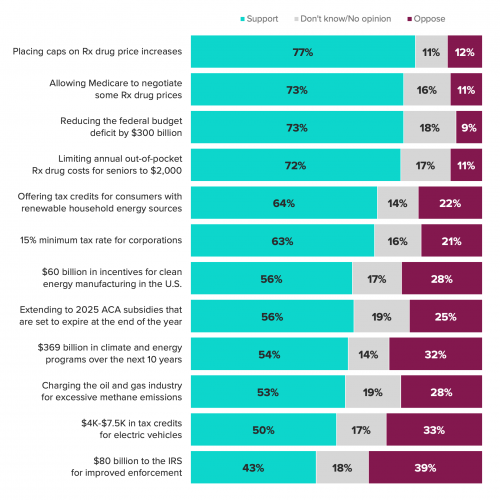
Source: Morning Consult/Politico
To this end, politicians may enjoy that sought after approval rating boost… for now. As the Brookings Institute explains, the lag in consumer perceptions about economic conditions paired with the all but guaranteed lag in impact and the significance of consumer sentiment in the voting booth could (and should) temper their optimism.
And in the meantime, those consumers are the engine behind the economy. Inflation is still high, companies continue to slash their workforce, and housing remains cost-prohibitive despite a dip — all of which indicates confidence is unlikely to jump and a recession is still quite possible. Time will tell. Keep your eyes on the horizon, and keep talking to your financial advisers about how to best protect your assets for what lies ahead.
[Editors’ Note: To learn more about this and related topics, you may want to attend the following on-demand webinars (which you can listen to at your leisure and each includes a comprehensive customer PowerPoint about the topic):
- Personal Finance & Investing Fundamentals
- All About Asset Allocation
- Advanced Investing Topics: Unicorns and Pre-Unicorn Scalable Private Company Propositions
Additional reading:
- 3 Tangible Asset Investments to Delight Your Inner Child
- The Investment Basics for Beginners Series
- Beware Venture Capital Unicorns
- Investing in a High Inflation Environment]
©2022. DailyDACTM, LLC d/b/a/ Financial PoiseTM. This article is subject to the disclaimers found here.
About The Financial Poise Editors
Financial Poise helps trusted advisors (accountants, attorneys, business brokers, consultants, financial advisors, investment bankers, etc.) by providing a meritocracy-based platform on which to demonstrate their thought leadership. The thought leadership of these advisors is expressed in the form of educational articles, so we can provide our readers high-quality, unbiased education about investing, owning a business…