

- Home »
- Weekly Commentary »
- The Case for Investing in Climate Adaptation and Climate Migration

The Case for Investing in Climate Adaptation and Climate Migration
This week in our newsletter:
- Americans have rarely felt worse about the economy, yet the stock market has never been better.
- Wall Street’s biggest banks are making a comeback.
- Prediction markets and crypto firms are raising fresh conflict-of-interest concerns.
Read the full newsletter for our analysis on these stories — shared exclusively in our newsletter.
Climate change. The question of whether, to what extent, and (assuming the answer to the “whether” question is yes), what is causing it, has been a politically charged issue for a long time. And for a long time, many treated it as a distant problem for future generations, distant governments, and the occasional documentary narrator.
One fundamental reason for this is that climate change is the ultimate global negative externality.
Here’s a quick Economics-101 interlude:
Positive externalities are unintended benefits that a third party receives from an economic transaction. The direct producer or consumer does not receive compensation for these widespread benefits. As a result, goods with positive externalities are often underproduced or underconsumed in a free market. Examples include vaccines, education, and R&D.
- Private benefit is the direct value received only by the consumer or producer.
- Social benefit is the total value to society, which equals the private benefit plus the external benefit to third parties.
- In economic terms, positive externalities create a gap between private gains and social gains.
- The Problem: Because the market only looks at private benefits, the good’s price doesn’t reflect its true social value, leading to market underproduction.
- Government Solutions: To correct this inefficiency, governments often step in to encourage consumption or production. Think: subsidies, grants, tax credits, or even public libraries and parks.
Negative externalities are unintended costs imposed on a third party by an economic transaction. Because neither the producer nor consumer pays for these hidden social costs, the product is artificially underpriced and overproduced.
But that old framing is changing fast. Climate risk has quietly moved from the op-ed page to the spreadsheet, and the smart money is already paying attention.
The data proves the point. The last three years have produced the three highest counts of billion-dollar disasters in the US since 1980. The average for those three years was 26 events. The annual average since 1980 is 9.2. In other words, we are now living through nearly three times the historical norm– and that is the average, not the bad year.
The insurance industry is making the same point with its balance sheet. According to Deep Sky Research, 1 in 5 homes in extreme fire risk areas in California lost insurance coverage between 2019 and the start of 2025. Insurers are increasingly pricing risk block-by-block– two houses on the same street can now get very different answers. When the people whose entire job is pricing risk start declining to price it at all, that is the market talking. An uninsurable house is not worth its asking price– it just hasn’t been told yet. For investors, the non-renewal letter is a leading indicator: it tends to arrive a few years before the comparable-sales data does.
The case is now building for two distinct but related investment theses. The first is climate adaptation, where investment opportunities lie in making the places people already live more resilient. The second is climate migration, where investors anticipate where people are heading as some of those places become harder to stay in.
They run on different assumptions and timelines, and both are worth understanding separately.

The Investment Case for Climate Adaptation
For this, we turn to the working paper, Strengthening the Investment Case for Climate Adaptation: A Triple Dividend Approach (World Resource Institute, May 29, 2025) (“WRI Paper”) that analyzed 320 climate adaptation investments across 12 countries.
They estimate that every $1 invested in adaptation can yield over $10.50 in benefits, with average annual returns of 20-27%. Those are venture-capital numbers attached to what most people still file under “charity.” You don’t have to believe a word about the climate to find a 10-to-1 payback interesting; you just have to believe in arithmetic.
To explain, the WRI draws out three layers of return:
1. Avoided Losses
This is the layer most analysts already model, and even on its own, it often justifies investment.
Early warning systems (EWS) are among the highest-return investments in the climate adaptation toolkit, saving lives and assets worth at least 10 times their cost. In fact, just 24 hours of advance warning before a storm or heat wave can cut ensuing damage by 30%. Think of an EWS as a smoke detector for an entire city– cheap, unglamorous, and worth many times its price the one time it goes off.
To give you a figure in dollar terms: spending $800 million on EWS in developing countries is projected to avoid $3-$16 billion in losses. That’s a return ratio that most asset managers would find difficult to ignore.
2. Economic Co-benefits
Adaptation investments often generate a ripple effect of returns well beyond the climate risk they address.
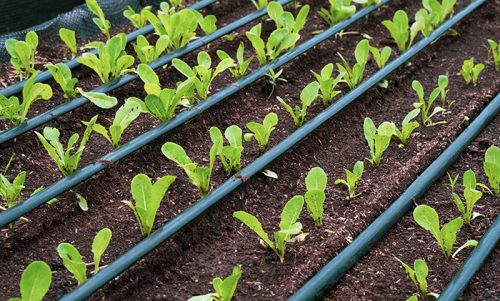
A good example is drip irrigation. It was developed as a response to water scarcity but has turned out to dramatically outperform traditional irrigation systems in crop yields. As a result, the inventors and purveyors of drip irrigation make money from customers who are not driven to purchase because of water scarcity.
3. Broader Social and Environmental Returns
This third layer is the hardest to price and the most frequently ignored. It covers the benefits that accrue to communities, ecosystems, and societies rather than to a specific investor. These returns are wide-ranging and diffuse, making them hard to capture with standard appraisal methods.
Take Mangrove forests as an example. The WRI Paper reports that Mangroves provide over $80 billion in annual avoided losses from coastal flooding and protect more than 18 million people. On top of that, they contribute $40-$50 billion annually in ‘nonmarket benefits,’ which go to fisheries, forestry, recreation, and coastal habitat. All in, the benefits from protecting and restoring mangroves are up to 10 times greater than the costs.
London’s investment in the Thames River flood protection is another example. The barrier was built to protect the city, but by dramatically reducing flood risk, it made the entire Canary Wharf development viable. That financial district now employs over 100,000 people and anchors one of the world’s leading banking centers. The adaptation investment unlocked a scale of economic activity that would have been impossible, or at the very least, far more expensive to insure, without it.
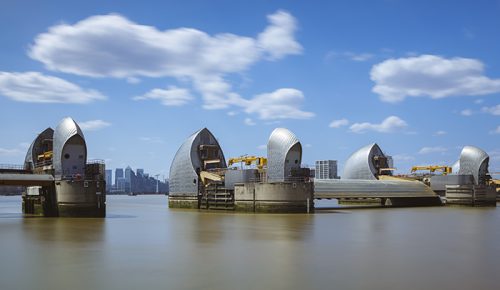
Thames Barrier
Mangrove forests and Thames River flood protection are both examples of a public good. So are libraries and roads, for that matter.
Another quick Economics-101 Interlude:
- Uncongested highways are technically public goods because they are available to all and don’t restrict others. However, they easily become excludable through mechanisms like toll gates or electronic tags (e.g., I-Pass).
- During rush hour, highways become rivalrous and congested. One car occupying space actively reduces the speed and increases travel time for everyone else, shifting the road from a public good to a common resource.
Climate adaptation has been chronically underfinanced, in part because investors and governments tend to price only the first layer, avoided losses, and treat the rest as a rounding error. That is the mistake. The WRI found that the value created by the second and third layers, the co-benefits and the broader social returns, often exceeds the value of avoided losses. That means the viability of climate adaptation investments doesn’t actually rely on the anticipated disaster ever occurring.
New OECD figures underscore the point. Wealthy nations fell short of their 2021 Glasgow pledge to roughly double adaptation funding for developing countries to about $40 billion a year by 2025. And a report released by the United Nations Environment Programme estimates that developing countries actually need $310-$365 billion annually for climate adaptation by 2035.
File this one under “problem” and “opportunity” at the same time. Every dollar a government doesn’t spend on resilience is a dollar of demand left sitting on the table for private capital. The WRI Paper puts the payback on adaptation north of 10-to-1; public budgets are walking away from that return for reasons that have nothing to do with the math. When the obvious buyer leaves the auction, the patient bidder gets a better price.
Here’s a riddle: What’s an area that needs more investment and that has a track record of producing good returns?
Answer: A market inefficiency. And, as any value investor will tell you, a market inefficiency is just an opportunity that hasn’t been properly priced yet. We made a related point a few years ago in We Didn’t Start the Fire, But We Can Still Sell Fire Extinguishers: you can make money by thinking ahead about what large numbers of people will need.
The scale of the opportunity is coming into focus. Bloomberg recently projected that investing in climate resilience is on track to grow into a $1.3 trillion market spanning every sector of the economy. That is no longer a niche; it is roughly the size of the entire global advertising industry.
For years, “climate investing” meant betting on the cure– solar panels, wind farms, electric vehicles. Adaptation is a bet on the symptoms: the world has already warmed, and someone has to sell the sandbags.
So, You Want to Invest in Climate Adaptation. Where to Start?
Here are ten categories which McKinsey flags as the ones investors should be watching:
- Resilient buildings and infrastructure: HVAC units, heat pumps, building hardening, etc.
- Water management and flood protection: improving water efficiency, drought resilience, flood control, stormwater management, and long-term water security.
- Grid hardening: improving energy resilience to reduce power outages during extreme weather events.
- Logistics and supply chain: tools that assist in the storage and transport of food, pharmaceuticals, etc.
- Water infrastructure: improving water quality and water scarcity.
- Resilient agriculture: tools that protect harvest yields from severe weather.
- Disaster prediction, prevention, and recovery: EWS, climate-monitoring tools, and emergency-response technologies.
- Wildfire and vegetation management: forest management, vegetation-clearing, and fire-detection technologies.
- Financial-risk transfer: specializedinsurance products designed for a faster and more transparent claims process in disaster events.
- Flood management: flood barriers, coastal protection, and emergency food services, etc.
Investing in Climate Migration
If climate adaptation is the bet that we fix the house, climate migration is the bet that we’re better off moving to a better neighborhood. Instead of asking how to make a place more resilient, it asks a colder question: where are people, capital, and jobs going to end up once staying put gets too expensive? Investors who answer that early tend to buy the destination before the crowd does.
These two arguments aren’t mutually exclusive, and a well-considered portfolio might hold both. The scale is the thing to internalize: as we have reported, climate migration over the coming decades will be one of the largest macroeconomic forces the world has ever seen, and it would be hard to overstate its eventual financial impact. That is not a reason to panic. It is a reason to do the homework while the homework is still cheap.

Investing in Farmland
In recent years, investors have gained increasing interest in farmland due to its stable long-term returns, especially during inflationary periods and market volatility.
Climate migration adds a new layer of tailwinds here. As climate pressures intensify, agricultural land in drought-prone or weather-volatile regions is becoming less productive. The shrinking supply of productive farmland in climate-stable regions has led to a surge in farmland prices.
It helps to understand why farmland behaves the way it does.
Let’s start with the demand side. The world is trying to feed a population growing by roughly 70 million people a year. That’s close to another Germany annually. As we explain in Food Scarcity Despair Creates a Need for Investment, the United Nations projects that global food production will need to climb about 70% by 2050.
Now look at the supply side: arable land in the US has been steadily declining over the past 25 years. Global arable land per person fell by about 20% from 2001 to 2023. So, there are more mouths to feed and less dirt. That is the entire farmland thesis compressed into one sentence, and climate migration simply sharpens it by reshuffling where the productive dirt sits.
The track record is the part that tends to surprise people, and we have laid it out before in Growing Greenbacks with Farmland Investing.
- The NCREIF Farmland Index returned 10.2% in 2022– a year the S&P 500 lost roughly a fifth of its value– because farmland tends to gain value when consumer prices rise rather than lose it.
- It is far calmer than the public markets: between 1992 and 2020, the index carried a standard deviation of about 6.9%, versus 17.1% for the S&P 500.
- And it has been durable through downturns. During the 2008 financial crisis and the COVID shock, farmland posted lower positive returns rather than outright losses; even the brutal 1980s farm recession produced only a roughly 4% dip.
In short, farmland is an asset that marches to its own drum– which is exactly what you want from a holding meant to anchor a portfolio against volatility elsewhere.
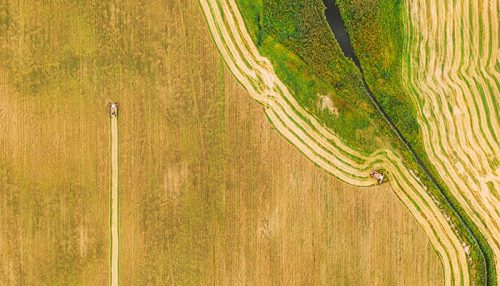
Agriculture is no small corner of the economy, either: nearly 18% of U.S. economic activity and about 30% of the country’s jobs are tied to the sector.
The tension between operator economics and asset values is worth flagging. Chapter 12 farm bankruptcies rose 45% in 2025 on tight margins and low commodity prices. Yet U.S. farmland values still climbed 4.3% over the year, as institutional investors and wealthy individuals kept treating the asset class as an inflation hedge.
Two facts that look contradictory may not be; they could just be measuring different things. Bankruptcies measure how hard it is to operate a farm this year; land values measure how much people want to own the dirt for the next thirty. Distress among operators is often exactly what hands the patient owner a cheaper entry.
Worth a caveat, though: if you’re buying farmland through a REIT or a crowdfunding platform, you are buying the dirt and the operator’s skill. The land may be forever; the tenant’s lease is not.
Farmland also intersects with several broader climate themes. Cropland may benefit from the shift toward plant-based diets, and agricultural land is increasingly being used for wind and solar development, creating additional income streams for landowners.
The solar angle deserves a closer look. A peer-reviewed study released this month finds that even if 40% of future U.S. solar projects were built on cropland, commodity prices would rise less than 5.6%.
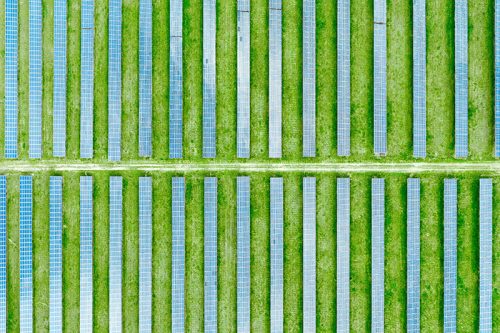
The “food vs. energy” framing makes for a good local zoning fight, but the data says it is mostly a false choice. Solar and wind leases routinely pay landowners more than farming lower-value cropland. A farmer doesn’t need a view on global temperatures to notice that an acre can earn more just by housing panels than working all season. For an investor in farmland, a second income stream that doesn’t depend on the weather is the whole point.
The plant-based angle is worth a beat more, because the economics are not sentimental. Livestock occupies roughly 80% of the world’s agricultural land while delivering only about 18% of its calories— and it takes something like seven pounds of grain to add a single pound of beef. Cropland, by contrast, is worth more than three times as much per acre as land used for livestock. If diets keep shifting toward plants, demand migrates toward the more valuable category of land, not away from it. That is a tailwind that does not depend on anyone winning a moral argument about dinner.
The good news for investors who don’t know anything about farming is that you don’t need to buy farmland directly. REITs, crowdfunding platforms like FarmFundr, and agricultural funds have made the asset class far more accessible.
It also helps to know that “investing in agriculture” is really three different bets.
- The first is land ownership— owning or leasing the dirt itself, where returns come from lease income and appreciation, and where regions with water, fertile soil, and infrastructure command the premium.
- The second is production— the farming operations, inputs, and technology (precision-ag sensors, drought-tolerant seed, vertical farming) that let the world grow more food with fewer resources.
- The third is post-production— the processors, cold storage, traceability, and branding that sit between the farm and the table, and that often carry fatter margins than the raw commodity. A farmer’s own profit margin is frequently under 4%, so the money tends to be made everywhere except in the act of farming. We unpack these layers in Food Scarcity Despair Creates a Need for Investment.
For a deeper look, see our earlier coverage: Growing Greenbacks with Farmland Investing and Investing in Farmland.
Investing in Climate-Advantaged Regions
Real estate and venture investment in climate-advantaged regions is another side to the climate migration thesis.
The economic revival of the Great Lakes region is a great example of this. The region holds roughly 20% of the world’s liquid surface freshwater and provides drinking water to 28 million people. It supports 1.3 million jobs and $82 billion in annual wages. According to a 2025 paper by researchers at the Cooperative Institute for Great Lakes Research, the regional economy would rank as the third-largest in the world if it were its own country, behind only the US and China.
The climate migration thesis also adds a forward-looking layer. The region avoids the wildfire risk of the West, the flood risk of the Gulf Coast, and the deepening water scarcity of the Southwest. Cities like Cleveland, Detroit, and Milwaukee were built for populations two to three times their current size– the infrastructure already exists, sitting underutilized and priced accordingly. Property values across the region remain well below coastal markets.
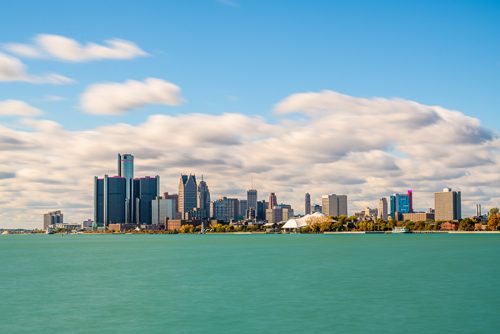
Detroit, Michigan
Great Lakes city planners are already in active discussions about preparing for climate migration, from zoning changes to higher-density residential development, to investment in freshwater infrastructure.
Cities that prepare early tend to attract capital early. And capital is already moving in. As we previously reported, venture funding across the region has been growing steadily, led by firms that relocated from the coasts specifically to access an underpriced innovation pipeline.
This is not theoretical. As we detailed in our interview on the Great Lakes economic revival, Drive Capital left Silicon Valley in 2012 to build a venture firm in Columbus and has since taken portfolio companies public. The federal CHIPS and Science Act has steered tens of billions toward Midwestern semiconductor capacity, with Intel committing an initial $20 billion to fabrication plants in Ohio and Micron planning a $20 billion chip facility in upstate New York. Some timelines have since shifted, and portions of the buildout remain uncertain, but the region’s real edge is the more than 20 globally ranked research universities clustered around an abundant freshwater supply. Talent plus water plus a relatively climate-advantaged platform is a combination most of the country cannot assemble at any price.
Follow the Water
If you read the adaptation and migration theses side by side, the same word keeps surfacing: water. As we have noted elsewhere, roughly 70% of the world’s freshwater already goes to agriculture, about half the global population faces severe water scarcity for part of the year, and two billion people lack reliable access to safe drinking water. Water is the constraint that makes farmland in drought-prone regions less productive, the reason coastal flooding is worth $80 billion a year to defend against, and the magnet pulling capital toward the Great Lakes. That is why “follow the water” is actually close to an investing instruction.
It also opens a category neither thesis fully captures: the water economy itself. Some of that is the “blue economy” building up around the Great Lakes– smart-water technology, monitoring systems, and the post-accelerators nurturing later-stage water-tech firms. Some of it is a newer financial market in water risk: the practice of pricing, for a given location, the odds that a facility simply runs dry. The most efficient way to reduce waste, after all, is to make wasting it expensive. Drip irrigation, for example, started as a scarcity workaround and became a yield machine. Expect more inventions to follow that arc– built to ration a shortage, kept because they were better anyway.
A fair warning before the closing pep talk: being directionally right is not the same as being paid. Land (farmland and raw land alike) is illiquid, can sit for years before a motivated buyer appears, and obligates you to pay property taxes whether or not the parcel throws off a dime. Financing is harder and pricier than a conventional mortgage; raw-land lenders often want a down payment roughly 30% larger. Zoning can also quietly veto your business plan, and a seller who has held the property only briefly is a yellow flag worth a hard look.
None of this kills the thesis. It just means the unglamorous work– location, water access, infrastructure, title history, market timing– is where the return is actually won or lost. We walk through that checklist in Investing in Raw Land: This Land Was Made for You and Me.
Adaptation bets carry their own version of the same caution. A smarter grid is only as valuable as the utility operating it, and a faster-paying insurance product still depends on the underwriter’s ability to manage claims. Even a compelling regenerative-farmland thesis has to work as an actual farming operation. And no matter how strong the underlying trend, overpaying for the asset still produces a poor return.

Playing the Long Game
Whether it’s investing in climate adaptation or climate migration, the timeline here is long and uneven. It’s entirely possible to be right on the thesis and still wrong on the timing or the specific investment. Due diligence remains non-negotiable.
But the direction of travel is certainly hard to ignore. The question for our readers is whether you’re positioned for it before the crowd figures it out– or after.
You don’t have to win an argument about climate science to take either of these theses seriously. Adaptation pays off whether or not the next disaster actually shows up. Migration simply follows people and water, two things that have been reliably predictable for a very long time. The mistake investors tend to make here isn’t betting wrong, but rather betting late. By the time a trend feels safe enough to act on, the discount you got for being early is already gone.
And what if you’re not a ‘do it yourselfer?’ Let’s say you don’t want to buy farmland or find a startup to invest in (which we typically discourage– see Private vs Public Companies: What Investors Need to Know Before They Invest (Part 2)).
Consider looking for mutual funds and ETFs that package the themes for you– agriculture and farmland funds, water-focused funds, climate-resilience and infrastructure funds, even broad real-asset strategies that hold a slice of all of it. You give up the control (and the bragging rights) of picking the parcel or the startup yourself, and you pay a manager for the convenience. In exchange, you get diversification, liquidity, and a far shorter due diligence list– which, for most investors most of the time, is a trade well worth making.
Adaptation and migration are long games. The good news is that you don’t have to play every position yourself to be on the field. Sometimes the smartest investor is not the person buying the farm, founding the startup, or building the seawall. Sometimes it is the person who simply notices, before everyone else does, that the water is moving, because money usually follows anything with that much gravitational pull.
About Amy Cai
Amy Cai is an Associate Editor at Financial Poise with over seven years of experience in editing, marketing, and public relations. She is passionate about storytelling and specializes in making complex business and financial topics accessible and engaging for broader audiences. Share this page:
About Jonathan Friedland
Jonathan Friedland is a principal at Much Shelist. He is ranked AV® Preeminent™ by Martindale.com, has been repeatedly recognized as a “SuperLawyer”, by Leading Lawyers Magazine, is rated 10/10 by AVVO, and has received numerous other accolades. He has been profiled, interviewed, and/or quoted in publications such as Buyouts Magazine; Smart Business Magazine; The M&A…