
- Home »
- Weekly Commentary »
- Private vs Public Companies: What Investors Need to Know Before They Invest (Part 2)

Private vs Public Companies: What Investors Need to Know Before They Invest (Part 2)
This week in our newsletter:
- America’s “Super Prime” Credit Club Is Booming
- Is Your AI Notetaker a Liability Waiting to Happen?
- Peanut Butter Belongs on Sandwiches, Not in Your Compensation Strategy
- Modern Parenting is Starting to Feel like Portfolio Management
Read the full newsletter here for bonus exclusive content.
Last week, we gave you the lay of the land when it comes to investing in companies that you are not involved in running. (If you missed Part 1, you can read it here.) In the past, for most people, this meant investing in publicly traded companies.
Private markets were once the exclusive playground of a relatively small group of sophisticated “accredited investors.” But now, the velvet rope around them has started to come down. Today, millions of unsophisticated accredited investors and millions of even less sophisticated non-accredited investors are inundated with ads that aim to separate them from their money, offering investment opportunities that many, if not most, would be better off avoiding.
These shifts are leading to a financial system where more money is flowing into markets that are harder to value, harder to exit, and significantly less transparent. This week, we’re digging deeper.
Welcome to Private Markets– They’re Thrilled to Have You (and Your Money)
Historically, the SEC has treated investing in private companies the way bartenders treat top-shelf liquor: not for everyone, and you have to prove you can handle it.
Private offerings were generally limited to “accredited investors” with whom the issuer (the company doing the offering) had a pre-existing relationship. The assumption was that they could both better understand and withstand the risk of loss. Less sophisticated investors were thus protected from the higher risks and the lack of transparency in private markets.
There are good reasons for the gatekeeping. First, private shares are less liquid. There is no exchange where you can punch in a ticker and sell at lunch; lock-up periods of 7 to 10 years are common. Second, private companies disclose far less than public ones, so investors are making decisions with a fraction of the financial information they’d have for a publicly traded company. The combination can be unforgiving for anyone who can’t afford to be wrong– or to wait.
Yet, private offerings have become increasingly accessible to everyday investors in the last decade or so. First, the pre-existing relationship rules were relaxed, and exceptions were created to allow non-accredited investors to invest in private companies. The requirement for issuers to verify accredited investor status was subsequently relaxed.
This happened in the name of leveling the playing field. The argument was essentially, ‘well, people can go to a casino and gamble their money away, so we should not stop them from doing it in the context of speculating on stocks.’ Read more in Facebook Is a Bad Investment Advisor.
More recently, rules limiting retirement funds’ investment in alternative assets, such as private companies, have been relaxed. We’ve written about this before in The 401(k) floodgates have opened. Please don’t drown.
This comes at a time when private equity has struggled to outperform the stock market. McKinsey estimates that in 2025, the top quartile of global buyout returns averaged 8%. In comparison, the S&P 500 saw an average return of 18%. Institutional investors are well aware of these trends– that’s why fundraising has fallen. Which raises an obvious question: if the people who do this for a living have decided they have seen enough, why is the industry suddenly so eager to find new buyers further down the food chain? Again, one polite answer is “democratization.”
A less polite answer is that when one pond dries up, a farmer needs to dig a new pond.
Or do we have it all wrong? (Spoiler Alert: we don’t).
Here’s a Facebook ad, combining a healthy dose of misinformation with two cups of FOMO:
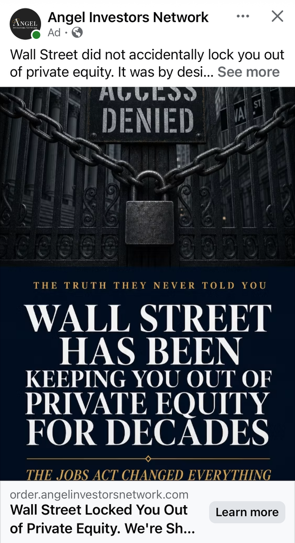
Bullshit. Wall Street didn’t lock anyone out of anything. The laws restricting certain investments to certain categories of investors weren’t cooked up by Wall Street bigwigs in wood-paneled clubs, cigars in hand, hoarding the best deals for themselves. Neither was the rule that used to bar issuers from soliciting investors they didn’t already know– a rule built on the 1933 Act’s private-offering framework.
These laws emerged from the wreckage of the 1929 crash- – part of a broader effort to protect investors, not to enrich insiders. Suggesting otherwise is just wrong.
Investors Beware: You Don’t Know What You Don’t Know.
As private markets continue to expand and access to them widens, investors are increasingly offered opportunities that come with undisclosed risks or, if disclosed, risks they do not understand. The challenge for investors is recognizing the limits of what they know about it– and being honest with themselves about whether they are equipped to live with what they don’t.
The issue, as Nir Kaissar, founder of Unison Advisors, explains in Bloomberg, is that there is now a “two-tier system” at play– public companies face extensive disclosure requirements, while private firms (even those that are similarly large) face far fewer obligations. The concern is that a significant portion of the financial system operates with limited transparency (or, as he writes, a kind of “black box”), where limited information can lead investors to misjudge risk or rely heavily on intermediaries.
We’re not suggesting completely avoiding investing in private markets. We are saying to exercise caution before you do. Oh, and if you see an investment opportunity advertised on social media or hyped up by a social media finfluencer, run the other way.
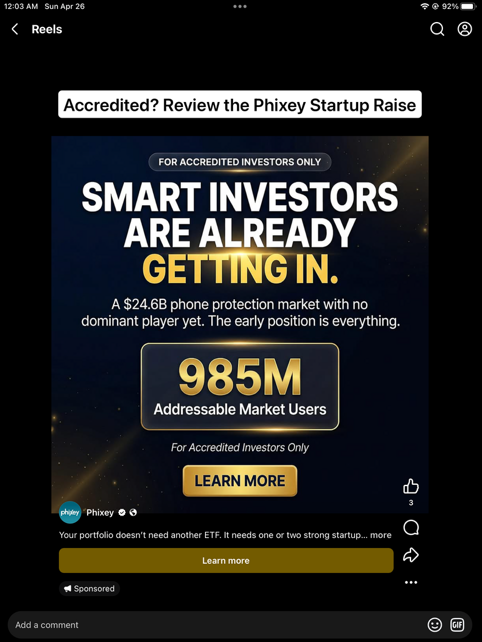
Or, perhaps, ignore us. After all, wouldn’t you want to invest in a $24.6 billion phone protection market with no dominant position? After all, “[t]he early position is everything.”
Let’s Look Under the Hood: Phixey
Start with the ad itself. The big banner reads “For Accredited Investors Only,” but the actual raise is on StartEngine, a Regulation Crowdfunding (“Reg CF”) portal open to anyone with $500 and a pulse. So the ad is, charitably, confusing about who can play, and less charitably, using the prestige of “accredited” to make a tiny consumer crowdfunding raise sound institutional. Either way, that’s a red flag before you read a single number.
To Phixey’s credit, there is enough public information to make a decision. The StartEngine offering page discloses a roughly $10 million pre-money valuation, a target raise of up to $1.23 million, and the explicit warning that “this investment is speculative, illiquid, and involves a high degree of risk, including the possible loss of your entire investment.” So you can read the financials.
The decision, however, should still be to pass. The ad’s premise– a $24.6B phone protection market “with no dominant player”– is, putting it politely, creative.
Asurion alone provides protection to over 230 million customers worldwide, Allstate Protection Plans (formerly SquareTrade) has over 140 million customers, and the major wireless carriers split most of what’s left. Saying there’s “no dominant player” in phone protection is like saying there’s no dominant player in soft drinks when Pepsi and Coke both exist.
An early-stage startup at a $10M valuation taking share from incumbents (Allstate has a ~$2.9B valuation and Asurion ~$9.7B) is an asymmetric long-shot bet. Or put another way, it’s a lottery ticket, not an investment thesis.
By the way, even without regard to the above, total addressable market is a pretty meaningless statistic by itself (Here’s Mark Cuban’s view).
Or wouldn’t you want to earn 25% annual returns by investing in a fund that invests in luxury beachfront properties?

Let’s Look Under the Hood: Signature Capital Partners
Signature Capital advertises two flavors of return on its own website: a Series A paying “15% APY” with a 12-month lock-up, and a Series B paying “25% APY” over a three-year term.
Take a breath before clicking. Bernie Madoff promised 10-12% returns. Allen Stanford promised something similar. There is no diversified hospitality real estate fund on planet Earth reliably paying its investors a 25% annual coupon, because hotels and villas simply do not generate cash like that, year in and year out. If they did, Marriott would do it.
A look at its website reveals that it has 125+ years of experience among its executive team. But on its “Meet the Team” page, we see 9 people listed. So, is that 13.89 years each? We can’t tell.
We also see that the website says “up to” 25% preferred returns, which is not what the Facebook screenshot says. Oh, but wait! We will also receive up to 10% of our investment value back as travel credits. Great! Combining investment decisions with vacation planning makes a lot of sense.
To be clear, we are not accusing Signature Capital Partners (or any of the companies running these or other Facebook ads) of fraud, of operating a Ponzi scheme, or of any other wrongdoing.
The references to Madoff and Stanford above are historical heuristics, not allegations. The point is that when a sponsor offers returns this far above market, the burden of proof on the sponsor is correspondingly high– and our criticism is that the public materials available do not, in our view, meet that burden.
When a sponsor markets a 25% guaranteed-sounding return and does not lead with audited statements, a track record, and a clear waterfall, the prudent assumption is that those documents would not help the pitch. Run.
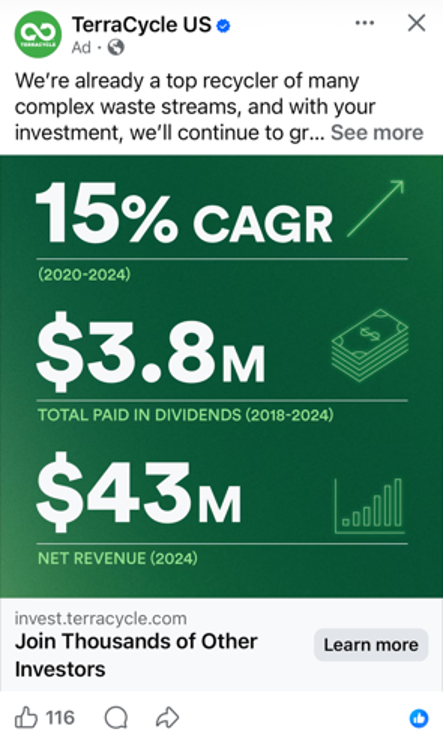
And what about joining the thousands of investors who have invested in a “top recycler of many waste streams” that has already paid investors $3.8 million between 2018 and 2024? Doesn’t that sound swell?
Let’s Look Under the Hood: TerraCycle US
This one is different from the other three, and a useful contrast. TerraCycle US has a $75 million Regulation A offering qualified by the SEC— “qualified” meaning the staff has reviewed disclosures and required actual financial statements. The current offering circular and prior SEC filings show audited numbers, such as $43.1M in 2024 revenue and $19.3M in 2024 gross profit. So yes, there may be enough information for the educated individual investor to make a smart decision.
That said, “enough information” is not the same as “good investment.” An informed read of those disclosures should also factor in:
- TerraCycle has been sued for greenwashing alongside Coca-Cola, P&G, L’Oréal, and others. (The case settled in November 2021 with labeling changes and the company paying plaintiffs’ fees.)
- A BBC investigation and a Bloomberg deep dive raised serious questions about whether the company actually recycles much of what it collects. (TerraCycle disputes those characterizations, describing the bales of waste BBC reporters traced to a Bulgarian incineration site as a “one-time incident” at a third-party processor and stating that “over 98% of the waste received is recycled.”)
- $3.8M in dividends over six years, spread across thousands of investors, is real but small– and the shares are still illiquid, with no exchange to sell them on.
So… Enough disclosure to decide. Decide what? How about whether the risks line up with the likely reward? For most investors, we think, a smarter way to bet on recycling is probably a public-market vehicle they can sell on a Tuesday.
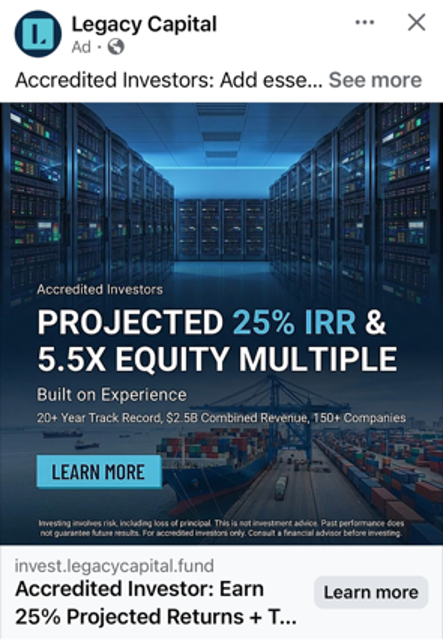
Or, if data centers are more your thing (at least that’s what the Facebook ad’s image suggests), you can earn an 25% IRR and a 5.5X equity multiple:
Let’s Look Under the Hood: Legacy Capital
Two things to know up front. First, the “25% projected IRR” and “5.5X equity multiple” on the ad are targets, not promises. The fund’s own materials describe them as “target returns of 3–5.5x MOIC and 25%+ IRR.”
In private-equity marketing, a “target” is the developer’s version of a real-estate listing photo taken in the best light, on the best day, with a wide-angle lens. Top-quartile global buyout funds, according to the same McKinsey data cited earlier, averaged about 8% in 2025.
Second, the headline statistics on the image– “20+ year track record, $2.5B combined revenue, 150+ companies”– describe the principals’ cumulative careers, not this fund’s realized returns. The founder, by the way, has less than four years of experience in private equity. We prefer our PE managers to be more well-done.
It appears there is insufficient public information to evaluate this offering. Rather, from our vantage, we’re essentially being asked to believe we’ll earn a 25% IRR on the basis of a photograph of a server room and a confidence-inducing logo. Pass.
Oh, but wait, there’s more: as we noted above, the image in the Facebook ad appears to be an interior view of a data center. But Legacy Capital’s website makes no mention of data centers. Rather, it suggests that its targets are the more than half a million middle-market companies whose owners will be retiring each year between now and 2035. Curious, to say the least.
To be clear, none of this is an allegation of misconduct. A Regulation D private offering is a lawful, accredited-only structure that, by design, does not require the public disclosures required by a Regulation A or registered public offering. Our criticism is solely about the practical due diligence question every individual accredited investor must answer: Can I meaningfully evaluate what is in front of me on the basis of publicly available, trustworthy information? On these materials, our answer is no.
The Takeaway
These example Facebook ads are a drop in the bucket. Social media is replete with “opportunities” like these; we picked this group at random.
Three of these four ads target the same problem from a different angle: each dangles a number designed to make you click (“$24.6B,” “25% APY,” “25% IRR”) and offers very little of the documentation that would let a careful person test whether the number is real.
The exception, TerraCycle, demonstrates the contrast: an SEC-qualified offering with audited financials gives the individual investor enough rope to do real diligence (and, in TerraCycle’s case, to find some real concerns).
That is the whole point of disclosure rules. When the ad uses the language of disclosure (“projected,” “accredited,” “track record”) without actually providing it, the educated individual investor’s correct response is to keep scrolling.
Taking a step back, here’s a rule of thumb we urge you to follow: any investment opportunity promoted on social media is one to avoid by virtue of being promoted there.
About Amy Cai
Amy Cai is an Associate Editor at Financial Poise with over seven years of experience in editing, marketing, and public relations. She is passionate about storytelling and specializes in making complex business and financial topics accessible and engaging for broader audiences. Share this page:
About Jonathan Friedland
Jonathan Friedland is a principal at Much Shelist. He is ranked AV® Preeminent™ by Martindale.com, has been repeatedly recognized as a “SuperLawyer”, by Leading Lawyers Magazine, is rated 10/10 by AVVO, and has received numerous other accolades. He has been profiled, interviewed, and/or quoted in publications such as Buyouts Magazine; Smart Business Magazine; The M&A…