

- Home »
- Entrepreneurship »
- Jackson Flooding and the Importance of ESG+R

Jackson Flooding and the Importance of ESG+R
If you’ve been paying attention to the news at all, it has been impossible to avoid horrific images of the catastrophic flooding in Jackson, Mississippi. When we say catastrophic, we mean a natural disaster beyond many people’s comprehension if you’ve never lived in a flood zone.
Video of the dangerous flooding in Brandon, Mississippi. pic.twitter.com/WGLK1S7C94
— WTVA Weather (@WTVAWeather) August 24, 2022
After being warned to evacuate the area ahead of predicted record rainfalls, residents who remembered the flooding in 2020 knew exactly what was coming. They weren’t wrong. As CNN reports:
The residents of Jackson, Mississippi – already dealing with flooded streets – are now also faced with another problem: There isn’t enough water to flush toilets or fight fires due to issues at the main water treatment facility, according to Mississippi Gov. Tate Reeves.
Because of the failure to produce running water, the state will help distribute drinking and non-drinking water to up to 180,000 people as crews work to get the water treatment plant back online, the governor said.
Until the system is fixed, there will not be reliable running water at scale, Reeves said. The governor said he was told Friday that it was a “near certainty that Jackson would fail to produce running water sometime in the next several weeks or months” if improvements were not made in the system, and officials began developing water distribution plans.
The problem was not unforeseen. Governor Reeves himself said they had just been “praying” they would have enough time – as in, to his mind, more than two years – to address the issue before the next bout of flooding hit. The problem is that the state has known for decades of the deficiencies. There are those blaming political animosity between the governor and mayor for the state’s failure to offer support, others blaming the mayor for not recruiting enough staff, others blaming political unwillingness by the state to ask for federal assistance soon enough. Those debates can wait for another day.
The bottom line? People are suffering, everyone saw it coming, and nothing was done.
Infrastructure Deficiency in a World of Climate Change
The science is not up for debate: climate change is real and it is causing real-world consequences right now. From flooding in Jackson to wildfires in California to a summer of record-breaking temperatures and beyond, major environmental events are happening as a symptom of climate change. There are a lot of reasons that this is a bad thing, one of which is that the country’s infrastructure – bridges, roads, power, water distribution, communications systems, and more – are all poorly equipped to withstand Mother Nature’s wrath. Primarily designed in the 1960’s and rarely updated since despite the population, many structures are reaching the end of their lifetime under the best of circumstances. From a sheer economic standpoint, the Council on Foreign Relations estimates that failure to invest in infrastructure could result in a loss of more than $10 trillion in GDP by 2039. And make no mistake: we are failing.
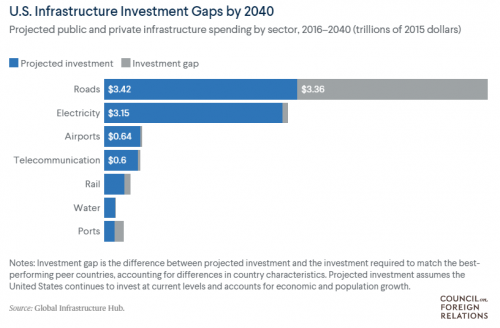 Source: Council on Foreign Relations State of U.S. Infrastructure Report
This is not a question. Put aside the dollar signs for a moment. As Jackson, and before that Kentucky, and countless other crises before that have demonstrated time and time again, lack of reinvestment in public infrastructure constitutes a national public emergency.
We tend not to talk about this problem until we’re already hurting, preferring to defer the conversation in the name of budget cuts. This reality, though, and delaying honestly and urgently grappling with it, only compounds the risk to people and places that would already be faced under the best of circumstances.
The most devastating cost in this equation is inarguably human lives. For those lucky enough to survive such catastrophes, however, there are additional costs associated with recovery. Though state and federal assistance can help shoulder some of those costs, they are historically not great at doing so effectively, efficiently, or equitably, leaving a great deal of the burden regrouping and rebuilding on citizens. This was starkly on display during the aftermath of Katrina, but the performance on display there is not an isolated incident nor accidental.
In theory, that’s what insurance should be for, right? But when you look at states like Florida – where legislation related to flooding and hurricane damage coverage came into effect – climate change has taken a different kind of toll. As Bankrate reports:
Florida’s property insurance crisis continues to worsen, despite recent legislative changes focused on stabilizing the rapidly collapsing home insurance market.
[…]Florida has always been a complex home insurance market, but recent issues are pushing the state’s market to the point of collapse. Since 2017, six property and casualty companies that offered homeowners insurance in Florida liquidated. Four more are in the liquidation process in 2022. Other insurance companies are voluntarily leaving the state. Still, more are choosing to nonrenew swaths of home insurance policies, drastically tighten their policy eligibility requirements or request substantial rate increases.
Florida might be the state making headlines, but they aren’t the only ones. They’re not even in the only country facing an insurance crisis tied to the increasing frequency and severity of climate change. And homeowners aren’t the only ones feeling the pain. Commercial real estate costs have been on a steady, alarming rise for some time now. The result has been some major corporations choosing to “self-insure” – setting aside massive amounts of money to cover potential damages themselves without having to jump through hoops with an insurance company or pay exorbitant premiums.
But what about small businesses? In states like Florida, they’re getting hit, too. It’s not like they can afford to self-insure. How do they protect themselves? The answer might lie in an ongoing conversation in insurance circles that hasn’t quite reached the public yet.
ESG… plus R?
The term ESG is not new. Consulting firm Gartner defines it as:
Environmental, social and governance (ESG) refers to a collection of corporate performance evaluation criteria that assess the robustness of a company’s governance mechanisms and its ability to effectively manage its environmental and social impacts.
Traditionally, the term has been used by financial professionals in evaluating the value of large companies. In recent years, it’s almost become a catchphrase – a pseudo-marketing tool used by advisers and funds to distinguish themselves in an era of activist investing (which in turn prompted SEC rulemaking on disclosures, which we’ll cover another time).
It also, however, has become increasingly relevant to insurance companies, with one important addition: resiliency.
Dr. Joan Lamm-Tennant of the International Insurance Society explains:
An ideal economy, community, business or individual will be both resilient and sustainable. Resilience is the capacity to recover from a disaster whereas sustainability is the ability to meet the needs of the present without compromising future generations. Building resilience in our economy, business and lives is dependent upon mitigating and managing the impact of risk but doing so in a sustainable way. Addressing environmental, social, and governance (ESG) challenges such as climate change and human rights issues presents an opportunity for risk managers, risk carriers, and investors in driving forward the resiliency and sustainability agendas of our stakeholders. Resilience is the future of sustainability.
That’s a pretty glossy version of the story. The more direct version is that, while a company’s response to and preparation for environmental, societal, and governance-related pressures or threats tells a story about their ability to financially persist and pivot, insurance companies are worried about a company’s ability to survive a natural disaster – what the industry would refer to as a catastrophic event (CAT). To this end, preparedness for such disasters can (and probably should) factor substantially into whether or not an insurance company is willing to extend coverage. It is not that resiliency exists outside of ESG policy so much as it will play an increasingly important role. As insurance technology enablement firm Archipelago Analytics co-founder Anthony Siggers put it:
I think, even now, investors and others looking at companies are starting to differentiate those companies that have a solid ESG policy and, frankly, set of actions in place, as opposed to those who aren’t. And I think that, over time, it will go beyond differentiation to just saying ‘no’. And we’re even seeing that in insurance now.
How Small Businesses Can Brace Themselves for a Natural Disaster Through Resiliency Planning
When we talk about resiliency, what we’re often thinking about is financially preparing to cover costs in case the worst happens. In a world of Climate Change, however, that also means preparing for Mother Nature to do serious damage. There are several ways you can double-down on resiliency:
Structural Reinforcements
If you’re in an area susceptible to serious natural disasters like wildfires, earthquakes, tornadoes, flooding, hurricanes, drought, or blizzards – in other words, anywhere – it would behoove you to make sure that any structures you own are prepared to withstand the elements. Examples of structural improvements might be installing impact-resistant glass windows, investing in shingle replacements and upgrades on your roof, adding a diagonal steel brace to chimneys, or building out an ember-resistant wall around your building. Professional engineers or consultants will be able to recommend the best investments for minimizing the impact of a natural disaster on your property.
Regular Inspections
Your initial investment in resiliency measures can provide significant ROI in case of a disaster. Time, however, takes its toll. Even without a major catastrophic event, general weather can degrade or damage these solutions. Scheduling ongoing inspections with an expert who can identify vulnerabilities in existing measures and opportunities for installing new ones can mean you stay on top of things before they get out of hand.
Inventory Protection Planning
If you’re a brick-and-mortar operation, your property may be a significant asset, but the contents of that property will be key to reestablishing any sense of normal operations. Ensuring your inventory is adequately protected in the case of a disaster could mean the difference between losing a week of productivity or a quarter. Ongoing protections can be useful in case of unpredictable events, but having a plan to secure your inventory even more effectively in advance of a known impending threat could make an even greater impact. It also makes sense to draw up a plan in case of emergency for replenishing stock and resuming operations, including considerations for supply chain disruptions.
Service Disruption Planning
Perhaps your business’ productivity depends on stable utility access. Maybe you, yourself, are a service provider with limited ability to control what happens to the infrastructure upon which you rely. Having a backup plan that is, ideally, geographically distributed, can limit your downtime and give you a communication method through which you can sustain your business.
Data Integrity Maintenance
This is the big one. Your insurance company is going to look at a wide variety of data points when evaluating the risk involved in insuring you and your assets. In many cases, the data provided by businesses follow traditional formulas will not directly incorporate the efforts and improvements you’ve tackled to make your resiliency more robust. Keep detailed, accurate records of every step you have taken, every system you have designed, and the exact value of your assets. Do not be afraid to go above and beyond when providing such information to your broker. Given that more than 90 percent of underwriters are dissatisfied with both the scope and depth of the data provided to them in the decision making process, this can not only affect whether or not you are accepted but the amount of coverage extended and the price you will pay for it. Beyond that, failure to submit a complete and accurate SOV means that even the insurance you have may not cover all of your losses at the end of the day.
Yes, Investing in Green Enhancements
It may be that your company does not directly need to be concerned about meeting ESG standards or explaining them policy to shareholders and investors… yet, at least. Still, investing in green technology can (in addition to probably just being the responsible thing to do as a citizen of the world by contributing to the maintenance of healthy ecosystems and for the sake of the most vulnerable in your community) offer your business resilience in the face of a metaphorical and sometimes literal storm.
Investing in renewable energy sources, for instance, can allow your business to function temporarily off-grid even if an power source such as solar panels are damaged by an event thanks to an integrated battery backup – which could fit nicely into your service disruption planning while simultaneously bolstering your brand integrity. Investing in green foam insulation retrofits not only saves you money on heating in the long run due to its effectiveness and durability but offer better protection from extreme cold or blizzards for both your inventory and potentially yourself. Those are just a couple of examples. A green technology expert may be able to provide other suggestions relative to your location.
Just in Case… Save
Many small businesses create a Rainy Day Fund for unpredictable circumstances that throw their company for a loop and even opportunities that are just too good to pass up. That makes sense. There should, though – particularly in this environment – be a portion of those funds earmarked for natural disasters and deemed entirely untouchable. If you’re able to maintain data integrity, you’re much more likely to get good insurance than you would be otherwise, but even then, you may find yourself with bills they won’t cover. Having some savings put aside means you are better able to bounce back faster without necessarily having to dip into your personal savings, or at least not as much.
Resiliency Includes Facing the Natural Disaster Reality
For a while there, ESG was considered to only be a concern for larger companies. Resiliency was merely a twinkle in an auditor’s eye. The world is a difference place today. While this all might seem like a whole lot of additional headaches piled on top of the traditional headaches that accompany running a business, they are nothing compared to the heartache experienced when ill prepared for a natural disaster. And while no one can be perfectly prepared for when the worst comes knocking, it is best to do all you can. It is better to be safe than sorry.
There are probably some people in Jackson today who could tell you as much, and more.
A SPECIAL NOTE FROM THE FINANCIAL POISE TEAM
Our hearts go out to those suffering in Jackson, Mississippi. Not only are they grappling with the flood damages to their businesses, homes, and property, but they are currently in desperate need of clean water. While donating to larger charitable organizations is always an option, we urge our readers to consider contributing as they can to the following local groups in order to most efficiently get help where it needs to go most:
The Mississippi Food Network
$15 can provide three cases of water.
Mississippi Rapid Response Coalition – Water Fund
A group of 30 Mississippi non-profits aiming to raise $2 million for water supplies during a shortage likely to last months.
New Horizon Ministries
Already active in Jackson and known to their most vulnerable communities.
Immigrant Alliance for Justice and Equity
Currently staging water giveaways and is raising funds in an environment safe for undocumented citizens.
Shower Power Mississippi
An organization providing mobile showers to those in need.
Cooperation Jackson
Specifically organizing to support the homeless, the elderly, and those with limited transportation by providing supplies and resources.
From the bottom of our hearts, we thank you for any effort you are able to make.
[Editors’ Note: To learn more about this and related topics, you may want to attend the following on-demand webinars (which you can listen to at your leisure and each includes a comprehensive customer PowerPoint about the topic):
- Business Property & Casualty Insurance 101
- Understanding Risk Management Basics for Business Owners]
©2022. DailyDACTM, LLC d/b/a/ Financial PoiseTM. This article is subject to the disclaimers found here.
About The Financial Poise Editors
Financial Poise helps trusted advisors (accountants, attorneys, business brokers, consultants, financial advisors, investment bankers, etc.) by providing a meritocracy-based platform on which to demonstrate their thought leadership. The thought leadership of these advisors is expressed in the form of educational articles, so we can provide our readers high-quality, unbiased education about investing, owning a business…