

- Home »
- Investing »
- Bed Bath & Beyond and the Meme Stock Revolution

Bed Bath & Beyond and the Meme Stock Revolution
There are many, many places you can find investing advice. Some of them actually offer good advice. But for a new generation of digitally-oriented investors, it turns out that said places have an online home with little gravitas.
It’s Reddit.
The often infamously lawless discussion board home has, understandably, attracted a great deal of activity for traders. Forget boiler rooms – these folks are all about social sentiment and, frankly, nostalgia. While a community most noted for a great deal of toxicity might not necessarily be the first place you think about for stock tips, it does have a bit of the same rule-breaking flavor that the site is known for as a whole. The question is whether it should garner your attention.
The problem is that even a passing glance at those conversations reveals a simple truth. Those in marketing will tell you quickly and often that content is king, but in the world of stock trading, social has usurped the crown. Recent news reveals the latest example in Bed Bath & Beyond. The Atlantic explained:
Bed Bath & Beyond is a struggling home-goods retailer whose underlying business is so bad that stories about the company carry headlines like “Bed Bath & Beyond’s Big Dilemma: Can It Survive?” But for most of August, Bed Bath & Beyond was also one of the hottest stocks on Wall Street, rising almost 500 percent in a matter of weeks.
Does that sound ridiculous to you? You’re not alone. But to understand the manifestation of such lunacy, your best bet is to look at history.
The GameStop Heist
Ok, maybe heist is the wrong word. This being said, what happened with GameStop in 2021 comes very close to being such.
The company was failing, and perhaps with good reason. After all, they had already been struggling before COVID hit as many gaming companies allowed for online game purchases which made going to the store seem obsolete. Factor in the pandemic, and it’s not really surprising that the big banks and hedge funds were shorting the stock.
On Reddit, many people who thought fondly of their journeys over to the local GameStop to pick up the latest edition of Call of Duty, a used copy of NBA2K, or the freshest iteration of Zelda were upset. They resented the financial institutions driving one of their favorite childhood retailers into the ground; others were frustrated that they would no longer have access to the stores in a hunt for collectibles.
So they fought back. As Vox reported at the time:
An army of traders on the Reddit forum r/WallStreetBets helped drive a meteoric rise in GameStop’s stock price in recent days, forcing halts in trading and causing a major headache for the short sellers betting against it and banking on the stock falling. It’s a captivating David vs. Goliath story, where David — at least on some fronts — appears to be winning.
They were definitely winning then, and those who were not used to the so-called “little guys” substantially swaying the markets were mad as could be. There was little but disdain and contempt thrown at these “amateurs”, but perhaps it was the Redditors that put it best themselves: it was a meme stock that blew up.
The Aftermath of a Meme Stock
As experts at the time predicted, the GameStop surge was never going to last. If you look at the difference in pricing near the height of the surge and compare it today… well, just look.
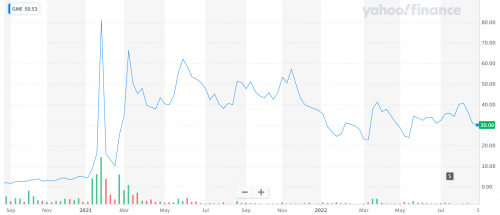 Source: Yahoo! Finance
After trudging along and facing a buyout, the stock went from soaring on the wings of those longing for yesteryear and using today’s technology to do it until they found themselves sinking once more.
Inevitable? Probably, but that likely won’t happen again. Even with stocks like Bed, Bath, and Beyond, AMC Entertainment Holdings, and Weber enjoying a boost from such enthusiasm, a lot of people lost a lot of money as leaders of the GameStop rally swore that all they had to do was hold on and things would get better. The surges are not the same now. Moreover, various ETFs have made it easier for the same kinds of retail traders to fight back against their former brothers in arms.
That doesn’t mean the meme stocks are going away, nor does it mean they are necessarily a bad idea. In fact, economist and Wharton School professor Dr. Jeremy Siegel has even argued that speculating is perfectly fine.
Speculating. That’s the key word in that last sentence. If your form of investing involves day trading, you might be able to ride the waves (assuming you’re playing it smart). Such stocks, however, are not for the faint of heart, requiring a high risk tolerance. If that’s not you, reaching out to your financial planner to insist they get you in can turn into mere performance chasing, and that benefits pretty much no one.
[Editors’ Note: There is an excellent documentary related to the GameStop story available on HBO Max. Check it out.
Looking for more articles related to this topic? Check out these:
- Investing Basics for Beginners: Never Put Your Eggs in One Basket
- Investing Basics for Beginners: Stocks Explained
To learn even more about this and related topics, you may want to attend the following on-demand webinars (which you can listen to at your leisure and each includes a comprehensive customer PowerPoint about the topic):
- Basic Investment Principles 101 – From Asset Allocation to Zero Coupon Bonds
- Alpha, Beta & Other Key Concepts]
©2022. DailyDACTM, LLC d/b/a/ Financial PoiseTM. This article is subject to the disclaimers found here.
About The Financial Poise Editors
Financial Poise helps trusted advisors (accountants, attorneys, business brokers, consultants, financial advisors, investment bankers, etc.) by providing a meritocracy-based platform on which to demonstrate their thought leadership. The thought leadership of these advisors is expressed in the form of educational articles, so we can provide our readers high-quality, unbiased education about investing, owning a business…