

- Home »
- Weekly Commentary »
- Why Organizational Change Happens Slower Than You Think

Why Organizational Change Happens Slower Than You Think
This week in our newsletter:
- America’s debt burden is climbing, with no signs of slowing down.
- Public backlash against AI is spreading into local politics and infrastructure fights.
- Wall Street is warning ordinary investors about the risks of the coming AI IPO frenzy.
- The Fed’s new chair is stepping into a political minefield.
- Gen Z entrepreneurs are outnumbering boomer entrepreneurs.
Ask any executive at any company over a Zoom call today what their top priority is, and you’ll get some variation of the same answer: agility, transformation, the ability to adapt at the speed of AI. Every company now seems eager to announce new AI initiatives or a digital transformation strategy, usually while using buzzwords like “disruption” and “innovation.” Bonus points if the PowerPoint includes an arrow pointing up and to the right.
Unfortunately, change tends to happen more slowly (and less successfully) than you may think. In fact, McKinsey estimates that 70% of change programs fail to reach their goals. That’s an abysmal track record. In most industries, it would trigger mass panic. If your airline had a 70% failure rate, you would not get on the plane. If your surgeon had a 70% failure rate, you would not lie down on the table. And yet executives keep launching change initiatives with this batting average, acting surprised when the next one stalls. So, it begs the question: why is change management so hard to implement?
According to McKinsey, the answer lies in two main factors: employee resistance and a lack of support from management. Much of this is inevitable. After all, companies are inherently designed to preserve stability, rather than to accelerate transformation.
To explain this a little more deeply, we turn to the fundamental “laws of the office”– a set of workplace dynamics that were the subject of a past episode of NPR’s Planet Money podcast. The podcast explores why organizational change so often stalls, and we build on those ideas with several practical suggestions for what businesses can actually do about it.

Goodhart’s Law: When Productivity Becomes the Target
Named after economist Charles Goodhart, the law states that when a measure becomes a target, it ceases to be a good measure. Employees stop caring about what that number is supposed to represent and start finding creative ways to hit it.
This often means technically satisfying your targets but losing sight of what the business actually needs.
We’ve seen this play out in a post-COVID world, where workplaces have announced stricter return-to-office mandates for their hybrid workers. But rather than driving more workers back to the office, it’s led to the trend of “coffee badging,” where workers show up for work long enough to scan their badge, grab a coffee, say hi to a few people, before heading back home. These workers have effectively figured out how to ‘game the system’ without really achieving the mandate’s real aims.
In an AI era where workers increasingly feel pressure to justify their value, companies aren’t likely to take their foot off the metrics pedal anytime soon. In fact, many are now tracking targets beyond output. Meta, Amazon, and Accenture, for example, are now tracking their workers’ AI tool usage and factoring that data into performance reviews and promotions. Their goal is to encourage AI adoption and use AI to drive greater impact. Will it actually work, though? If Goodhart’s Law is anything to go by, the answer is no. Setting AI usage as a performance metric likely won’t drive real innovative thinking.
There are several ways that you can try to combat this law in your own workplace:
- Be clear on the actual aim your metrics are driving. Evaluate each metric by questioning whether it’s truly driving the aim. If it is, then make sure to communicate that aim clearly.
- Set diverse metrics that support one another. Ensure each metric is narrowly defined. For example, if you set one metric for the number of client requests and another for the number of client requests completed, you can prevent workers from falsely completing requests by adding a third metric for client satisfaction.
- Include qualitative measures. This can be feedback from colleagues, which provides deeper insight into performance beyond specific outcomes.
- Provide incentives encouraging workers to improve rather than game the system. People are motivated to help change the system when they are rewarded for it.
Parkinson’s Law: Work Expands to Fill the Time it’s Given
The law comes from a satirical essay by British naval historian C. Northcote Parkinson. You most likely already understand this principle from school. Think about the time when you frantically worked on a two-week assignment the night before it was due. We’ve all been there.
Here’s a graph to illustrate this:
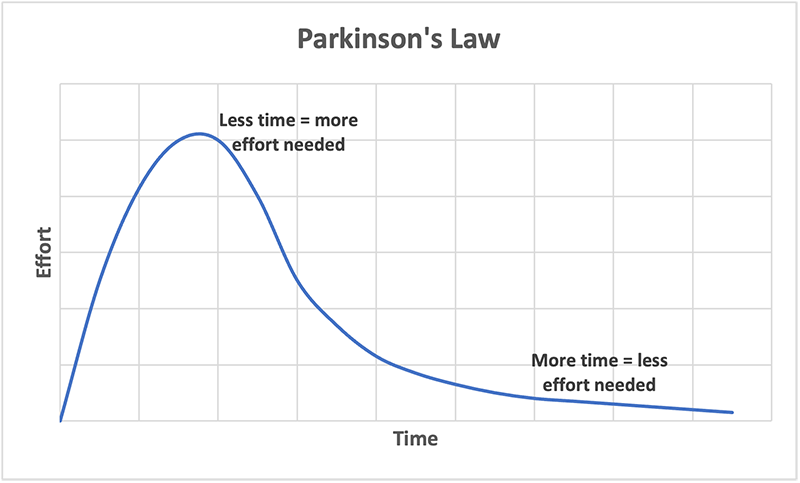
In change management, Parkinson’s Law often reveals itself when too much time is spent in status meetings, alignment sessions, and stakeholder check-ins. There’s always more time to talk about the work than to actually do it. In larger organizations, that problem is magnified by multiple layers of approvals, where no one wants to be blamed if something goes wrong.
Thankfully, there are a few ways you can fight Parkinson’s Law:
- Shorten your deadlines (within reason, of course). Avoid setting overly generous deadlines that encourage workers to procrastinate or over-complicate the process.
- Offer a reward for fast task completion. It may be worth implementing an employee incentive program to motivate your workers. Rewards outside of a cash bonus can include profit sharing, extra time off, or leadership mentorship.
The Peter Principle: Great Employees Often Become Bad Managers
This is a management principle developed by Lawrence J. Peter, who argued that in a hierarchy, employees tend to rise to their level of incompetence.
The workers who excel in their current roles are usually the ones who get promoted, but they often perform worse as managers, when the skills that got them recognized in the first place no longer determine their success. In other words, the traits that make someone promotable and the traits that make them a good manager often actively work against each other.
Think of this as the corporate version of asking your best chef to also run the restaurant. The food gets worse, the chef is miserable, and the customers can’t figure out why their favorite place isn’t what it used to be.

This isn’t just workplace folklore. A large-scale study published by the National Bureau of Economic Research found that across over 200 firms, the better a sales rep was at sales, the more likely they were to get promoted– and the worse they tended to be as managers. In fact, the high-performing sales reps who doubled their sales before getting promoted were also associated with a 7.5% drop in their new team’s sales performance once they became manager.
But here’s the kicker: companies understand this principle but do it anyway. Promotions are a motivational tool in the workplace, and many firms have decided that weaker management is an acceptable trade-off for keeping their best performers hungry.
The problem is that this sort of promotion creates a lose-lose situation. On one hand, they can create misery among people who are put in roles that move them away from what they actually enjoy doing. On the other hand, the company loses an exceptional worker while gaining a mediocre manager.
There are several ways that organizations can try to combat this principle:
- Promote employees with leadership potential to managers. These employees should stand out for their people-management skills, not simply because they excel in a technical role.
- Evaluate managerial ability before making promotions. This may mean assigning short-term leadership roles based on a project, where you can assess an employee’s capability as a manager.
- High-performing specialists should have alternative advancement pathways. Rather than pushing them into management unwillingly, a new path should be set out for these employees to gain compensation and status in the company. Google, for example, offers a distinct specifically for the engineers who prefer staying on a technical path. ‘Individual Contributor’ career path specifically for the engineers who prefer staying on a technical path.
Social Change Accelerates when We See Others Changing

This final idea discussed on Planet Money is the notion that people often do want to change– they just want to see someone else do it first.
The argument made by Alice Evans, a lecturer at King’s College London, is that once you show people the “social proof” that others have made the change, change starts to feel like the new normal.
Employees may privately support a new process, technology, or workplace norm, but they are often reluctant to be the first person openly embracing it. That’s because there is a social risk in standing apart from the group, especially in large organizations where conformity is often rewarded. Anyone who has ever been the first person on the dance floor at a wedding understands the dynamic. The music has been on for twenty minutes, everyone wants to dance, and yet no one moves until someone braver (or drunker) breaks the seal. Workplaces are no different, except that weddings end, and workplaces don’t.
There are several ways organizations can encourage this type of momentum:
- Publicize early adopters and successful pilot programs. People are more likely to embrace change once they can see their peers successfully adopting it and benefiting from it.
- Encourage teams to adopt changes together. Workers are more willing to change when new behaviors feel socially accepted within their group.
- Focus on creating momentum first. Social change tends to accelerate once employees believe the shift is genuinely taking hold.
Organizational change rarely stalls because of a single bad actor or a single flawed plan. More often, it’s the accumulated weight of incentives, bureaucracy, hierarchy, and plain human nature all pulling against change at the same time. Ultimately, businesses are made up of people, and people rarely transform overnight just because leadership added the word ‘innovation’ to a slide deck.
Our take? If you’re a leader trying to change your organization, the first thing to accept is that you are working against gravity. Goodhart, Parkinson, and Peter all show up to every meeting, whether you invited them or not.
The good news is that gravity is also predictable. Once you understand the forces working against you, you can stop being surprised by them and start designing around them. The companies that successfully change aren’t the ones with the best PowerPoint decks or the loudest CEOs. They’re the ones that quietly do the unglamorous work of aligning incentives with the behavior they actually want, and that have the patience to let the social proof build before declaring victory.
About Amy Cai
Amy Cai is an Associate Editor at Financial Poise with over seven years of experience in editing, marketing, and public relations. She is passionate about storytelling and specializes in making complex business and financial topics accessible and engaging for broader audiences. Share this page:
About Jonathan Friedland
Jonathan Friedland is a principal at Much Shelist. He is ranked AV® Preeminent™ by Martindale.com, has been repeatedly recognized as a “SuperLawyer”, by Leading Lawyers Magazine, is rated 10/10 by AVVO, and has received numerous other accolades. He has been profiled, interviewed, and/or quoted in publications such as Buyouts Magazine; Smart Business Magazine; The M&A…