
- Home »
- Weekly Commentary »
- Workplace Fatigue: A Leadership Problem in Disguise

Workplace Fatigue: A Leadership Problem in Disguise
This week in our newsletter:
- Viral Online Narratives Are Increasing the Risk of Market Shocks
- Corporate America Begins Its Race for Tariff Refunds
- Fresh Private Credit Concerns Are In the Air
- The Private Equity Dry Spell Continues
Read the full newsletter for our analysis on these stories — shared exclusively in our newsletter.
To the business leader or senior executive reading this: how energized is your team feeling? (And no, “They’re energized enough to answer Slack at 11:47 p.m.” does not count as “energized.”)
Glassdoor’s word of the year for 2025 was “fatigue.” Mentions of “fatigue” had risen 42% on Glassdoor Community, with workers citing concern over political headlines, economic uncertainty, and the rise of AI disruption. A clear undercurrent here is anxiety about job stability, which isn’t surprising considering the weak job market.
In fact, following annual revisions, the Bureau of Labor Statistics reported that the economy added just 181,000 nonfarm jobs in all of 2025, making it one of the slowest years for job growth outside of a recession in more than a decade.
The (somewhat) good news is that 2026 is showing early signs of improvement. The latest jobs report shows that employers added 130,000 nonfarm jobs in January 2026 alone. But hiring is still concentrated in a narrow band of industries, in particular health care, which accounted for 82,000 of those new roles.
Meanwhile, workers are choosing to stay put in their jobs amid market uncertainty. A recent survey by Resume Builder found that 6 in 10 workers are currently “job hugging.”
As the labor market tries to regain momentum and anxieties remain heightened, keeping workers engaged is more critical than ever for business leaders.
The Leadership Behavior That’s Making Things Worse
You’ve probably already considered solutions like adjusting workloads or boosting team morale. Maybe you’ve organized a wellness seminar or implemented productivity tools. These are all common ways to try to tackle employee exhaustion and burnout.
But such measures can be of limited benefit and can even be counterproductive.
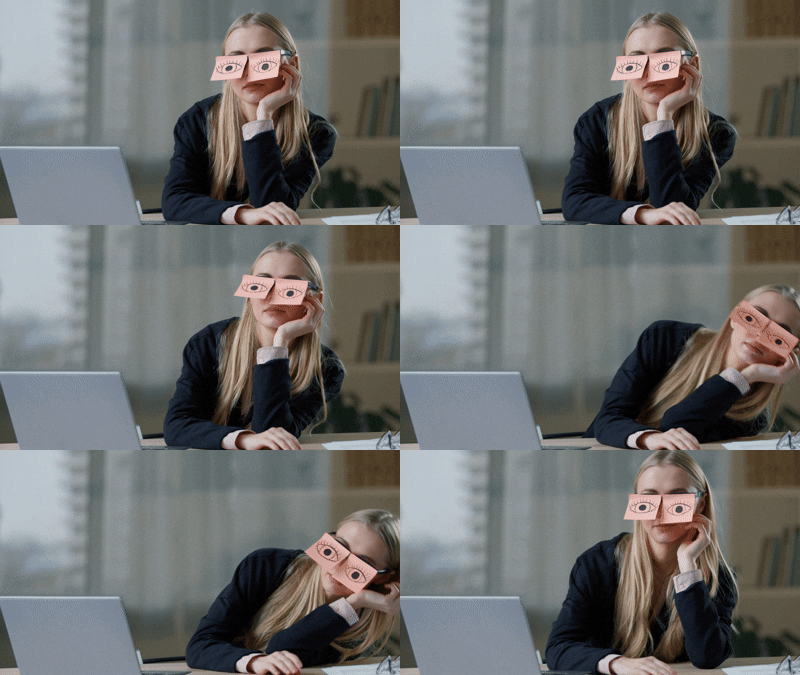
According to a study published this month in Harvard Business Review, researchers found that workplace fatigue often triggers “surface acting.” This is where workers and leaders adopt the emotional responses they think are expected of them in the workplace and quash any sincere feelings they fear won’t be professionally well-received.
It’s the practice of faking enthusiasm, positivity, or calm in professional settings, even when those emotions are not genuinely felt.
As it turns out, when it comes to workplace fatigue, it’s not always best to fake it till you make it. Sometimes you don’t make it. Instead, you just successfully impersonate a functioning adult until Friday rolls around.
While often framed as professionalism, surface acting also carries a measurable cost.
On a personal level, it creates a self-reinforcing cycle. Workers who begin the day already low on energy are more likely to rely on surface acting. But masking emotions consumes additional cognitive and emotional energy, further depleting their reserves and leaving them even more fatigued the next day. Over time, that cycle compounds.
At an interpersonal level, surface acting reduces authenticity in interactions, weakens trust, and diminishes the quality of collaboration. And if you’re a business leader, the effect of surface acting is magnified: your team can probably sense the strain, but they’ll most likely follow your lead, feeling pressured to mirror the same performative positivity.
Workplace Fatigue Also Comes with a Price Tag
Companies face a significant financial toll when workplace fatigue is left untreated.
Research published in the American Journal of Preventive Medicine found that over the course of just one year, employee disengagement, overextension, ineffectiveness, and burnout cost employers an average of:
- $3,999 per non-managerial hourly employee
- $4,257 per non-managerial salaried employee
- $10,824 per manager
- $20,683 per executive
Those costs stem from higher turnover, absenteeism, lower productivity, and increased health claims– all downstream effects of workplace fatigue.
Zooming out further, according to the Journal, in a typical 1,000-person US company, burnout-related conditions translate into approximately $5.04 million in annual costs.
In a job market where businesses aren’t hiring at the rate they once did, organizations really can’t afford to deplete their existing workers and compound their financial strain.
So, What Beats “Fake It Till You Make It”?
We’re not suggesting that business leaders should abandon all professionalism. At the same time, professionalism does not require constant emotional performance.
Going back to the Harvard Business Review research, there are a few sustainable solutions to surface acting that can preserve both energy and effectiveness.
1. Practice “Deep Acting,” Not Surface Acting
Professionalism does not require perpetual cheerfulness. The better alternative to surface acting is what researchers call “deep acting”– the process of genuinely aligning your internal emotions with external expectations.
A challenging meeting can be reframed as a problem-solving opportunity. A difficult quarter can be viewed as a strategic inflection point.
Because deep acting aligns mindset and behavior, it consumes less emotional bandwidth than masking feelings. Over time, it also strengthens resilience.
2. Reduce Emotional Overhead and Build in Recovery
Breaking the fatigue cycle requires reducing unnecessary emotional demands and protecting recovery time.
Leaders should cut down on performative meetings and ensure check-ins focus on concise, clear status (and if the meeting could’ve been a sentence in an email, it probably should’ve been).
Giving yourself small windows of recovery time is also key to regaining your energy. This may mean:
- Scheduling buffers between demanding meetings.
- Protecting focused work blocks.
- Encouraging genuine disengagement after hitting major deliverables.
3. Align Incentives with Outcomes, Not Optics
If your organization implicitly rewards visible enthusiasm, constant availability, or “always-on” responsiveness, then you are inadvertently incentivizing surface acting.
Leaders must clarify that results, judgment, and execution matter more than performative energy. This top-down communication will shift cultural norms and signal that authenticity is acceptable.
Authenticity is the Competitive Advantage in Business Leadership
In an age of AI and rapid disruption, faking it has become easier than ever.
Generative AI is now remarkably good at producing human-like writing, yet studies (talk about studying the obvious — next up in the research pipeline: people prefer it when their leaders sound like people, followed by people on death row more likely to die) show that when employees believe their CEO’s message was AI-generated, they view it as being less helpful. Employees tend to mirror their leaders, so when communication from the top sounds scripted, surface acting spreads– and with it, workplace fatigue.
So, beyond workplace initiatives and productivity improvements, the real solution to workplace fatigue often simply begins with authentic leadership.
About Amy Cai
Amy Cai is an Associate Editor at Financial Poise with over seven years of experience in editing, marketing, and public relations. She is passionate about storytelling and specializes in making complex business and financial topics accessible and engaging for broader audiences.
About Jonathan Friedland
Jonathan Friedland is a principal at Much Shelist. He is ranked AV® Preeminent™ by Martindale.com, has been repeatedly recognized as a “SuperLawyer”, by Leading Lawyers Magazine, is rated 10/10 by AVVO, and has received numerous other accolades. He has been profiled, interviewed, and/or quoted in publications such as Buyouts Magazine; Smart Business Magazine; The M&A…